
INNOVATION STRUCTURE DESIGN
Your innovation system
was built for improvement,
not opportunity creation.
A few management decisions determine which opportunities your system can create. Change those decisions, and the system changes with them.
No transformation program required.
SOUND FAMILIAR?
You have invested significantly in innovation…
You have hired capable people and built a dedicated innovation team, unit or hub.
You have introduced various methods, stage gate processes and innovation funnels.
You have explored open innovation and worked with concepts such as ambidexterity.
Innovation is professionally managed, funded, and visible to leadership.
Employees are engaged and ideas are collected across the organization.
Governance is in place, with portfolio planning and innovation reviews.
You've done many things right, but impact is limited.
Your teams deliver improvements reliably. What rarely emerges is the opportunity that changes what your organization can offer, and to whom. The cause lies in how your system decides, and when.
Professionally managed innovation systems determine too much, too early.
Search fields determine where to look.
Idea management determines what counts as an idea.
Funnels determine what moves forward.
Stage gates and KPIs determine what counts as progress.
And the business case determines what is worth doing.
Each is a proven management practice, reasonable on its own.
Together, they create a system that is unable to surprise itself.
Decide what stays open.
Innovation needs structure.
But not everything should be decided in advance. Structure Design rests on one principle: Underdetermination.
It means leaving the right questions open for long enough
while providing just enough structure for innovation to emerge.
Move the levers and see where your system sits.
Decisions
Mandate
Improve the CoreApproach
Customer CentricFocus
Problem SolvingScope
Strategy AlignedProgress
MeasurementOrganize
ProcessHow to read this model
Process means a fixed sequence with predetermined steps and outcomes. Project means bounded work that can adapt as learning unfolds. Measurement means predefined success criteria. Judgment means contextual evaluation supported by evidence. Conflicting Expectations highlight tensions to resolve. They do not predict failure.
Selected Organizations we’ve worked with.
ARBURG
Bacardi
BASF
Boehringer Ingelheim
Continental
DZ Bank
ESA
e.on
Ford
FSC
Generali
Henkel
Kaldewei
Mercedes Benz
Porsche
Provinzial
Roche
Signal Iduna
Telefonica
Unicef
ARBURG Bacardi BASF Boehringer Ingelheim Continental DZ Bank ESA e.on Ford FSC Generali Henkel Kaldewei Mercedes Benz Porsche Provinzial Roche Signal Iduna Telefonica Unicef
WORKING TOGETHER
Work on the layer most innovation systems miss.
Most organizations work on ideas, funnels, projects, and portfolios.
Innovation Structure Design works one layer deeper:
on the structural choices that determine which opportunities are created, protected, funded, and turned into business value.
Read the market.
Find leverage points.
Market conventions
We examine where your market has become crowded, where competitors follow the same conventions, and where customers are accepting weak tradeoffs.
System constraints
In parallel, we identify which processes, decision rules, funding logic, and review formats currently limit Opportunity Creation.
Make the critical decisions.
Together, we decide which structural choices need to change and which opportunity areas are worth pursuing. This is where system redesign and business potential are brought together.
Reset the decisions.
Advance the opportunities.
Innovation Structure Design
We change the criteria, review questions and decision rights that determine how opportunities are selected and protected, inside your existing system.
Opportunity Creation
We sharpen the selected opportunity areas, connect them to market dynamics and business value, and translate them into the next practical moves.
Where does your system decide too early?
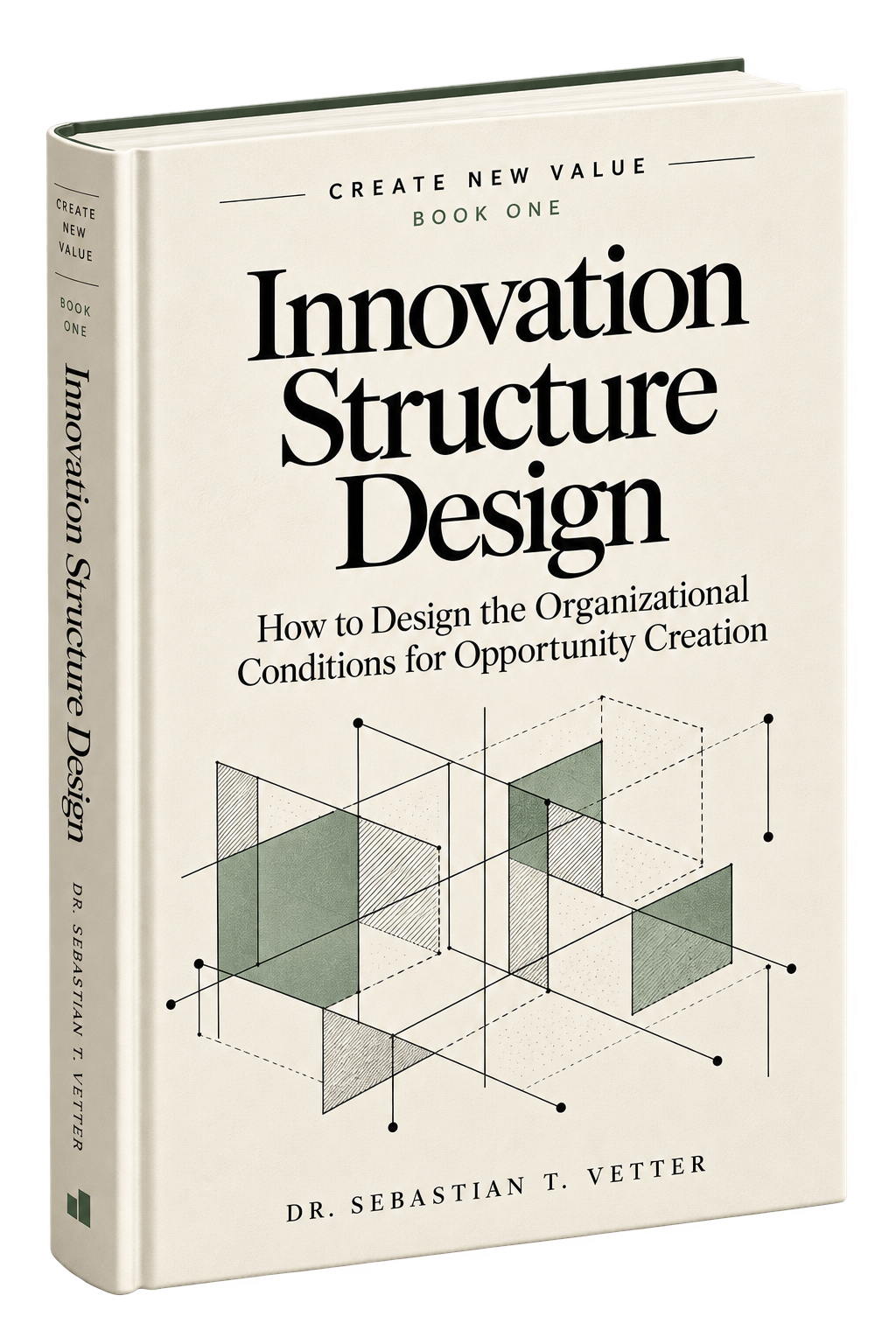
The thinking on this page is developed in full in the book Innovation Structure Design.
In a first conversation, we look at your innovation system and identify the few decisions that shape which opportunities it can create.