Why Innovation Units Fail. Five Patterns You Need to Recognize: 01 The Engagement Cycle.
A short Series On The Dynamics of Innovation Units, Labs and Hubs.
Understanding the patterns and key decision points that turn innovation into theatre.
Innovation Theater is the easy villain.
Whenever an innovation lab, hub, or unit underdelivers, the finger is quickly pointed at innovation theater. Too much show, not enough substance.
But in 15 years of working with innovation managers and senior executives, I have never met anyone who set out to create Innovation Theater. Not once. Nobody wakes up in the morning thinking: “Let’s make innovation look good on stage, but irrelevant in business.”
What actually happens is more subtle, and more dangerous.
Innovation slips into theater
Not by choice, but through a series of unnoticed dynamics. They start with the best intentions: making innovation work, creating value for customers, and driving the business forward. Yet despite these intentions, many units end up performing for visibility rather than delivering for impact.
So, how does that happen? How do smart, committed innovators, often with strong sponsorship and genuine ambition, find themselves trapped in theater?
My answer is: because of patterns.
Over the years, I’ve observed five recurring patterns that quietly shape the trajectory of innovation units. Each has a distinct dynamic. Each begins with a decision that feels logical in the moment. But once you’re inside, the dynamic reinforces itself, making it hard to escape and even harder to see alternatives.
These are not abstract theories. They’re grounded in my practical work across industries and geographies, in units that succeeded and in units that shut down.
Understanding these patterns is the first step to avoiding them.
Because Innovation Theater is not the cause of failure, it’s a symptom. The cause lies in the choices, structures, and assumptions that quietly set the stage long before the curtain rises.
In this series, I’ll walk you through the five most common ones:
Pattern 1 – The Engagement Cycle
Pattern 2 – The Cost Center Trap
Pattern 3 – The Startup Hype
Pattern 4 – The Overengineering Loop
Pattern 5 – The Fancy Lab Effect
What it is
The Engagement Cycle begins with the best intentions: to make innovation participatory, inclusive, and visible.
Yet over time, energy shifts from creating external value to maintaining internal visibility. The theater grows, the impact shrinks, and engagement declines.
How it starts
Innovation units are often launched understaffed, underfunded, and over-promised.
With limited resources and no decision rights, they face an early choice:
To either become a driver of innovation, OR
an enabler for the rest of the organization.
Many choose the enabler path. It feels safer, more inclusive, and achievable with a small team. And once you’re an enabler, the easiest activity is engagement.
However, you’re engaging innovation amateurs.
And what is a safe way to engage with amateurs?
Ask them for their ideas, because everyone has ideas.
And that’s where the cycle begins.
The two entry paths that converge
There are two typical ways innovation units enter the Engagement Cycle, and both lead to the same place.
Path B begins with high engagement.
Participation surges. Hundreds of ideas flow in from across the organization. A small team spends weeks, sometimes months, sorting, clustering, and ranking submissions.
Most ideas are unqualified; few have sponsors or budgets. Feedback to contributors is slow or nonexistent.
Disillusionment spreads, enthusiasm fades, and eventually engagement drops. The team concludes that it now has… an engagement problem.
Path A begins with low engagement.
Participation in campaigns and events is modest. The team diagnoses a communication problem and concludes that employees simply don’t understand what the innovation unit does.
In response, they pivot toward internal marketing. Building slide decks, holding town halls, and running awareness campaigns to increase participation.
Engagement metrics start to improve, but business outcomes do not. The team gains visibility, but not credibility.
Both paths converge on the same loop.
Engagement becomes the goal in itself. The unit begins optimizing for internal visibility instead of external market value.
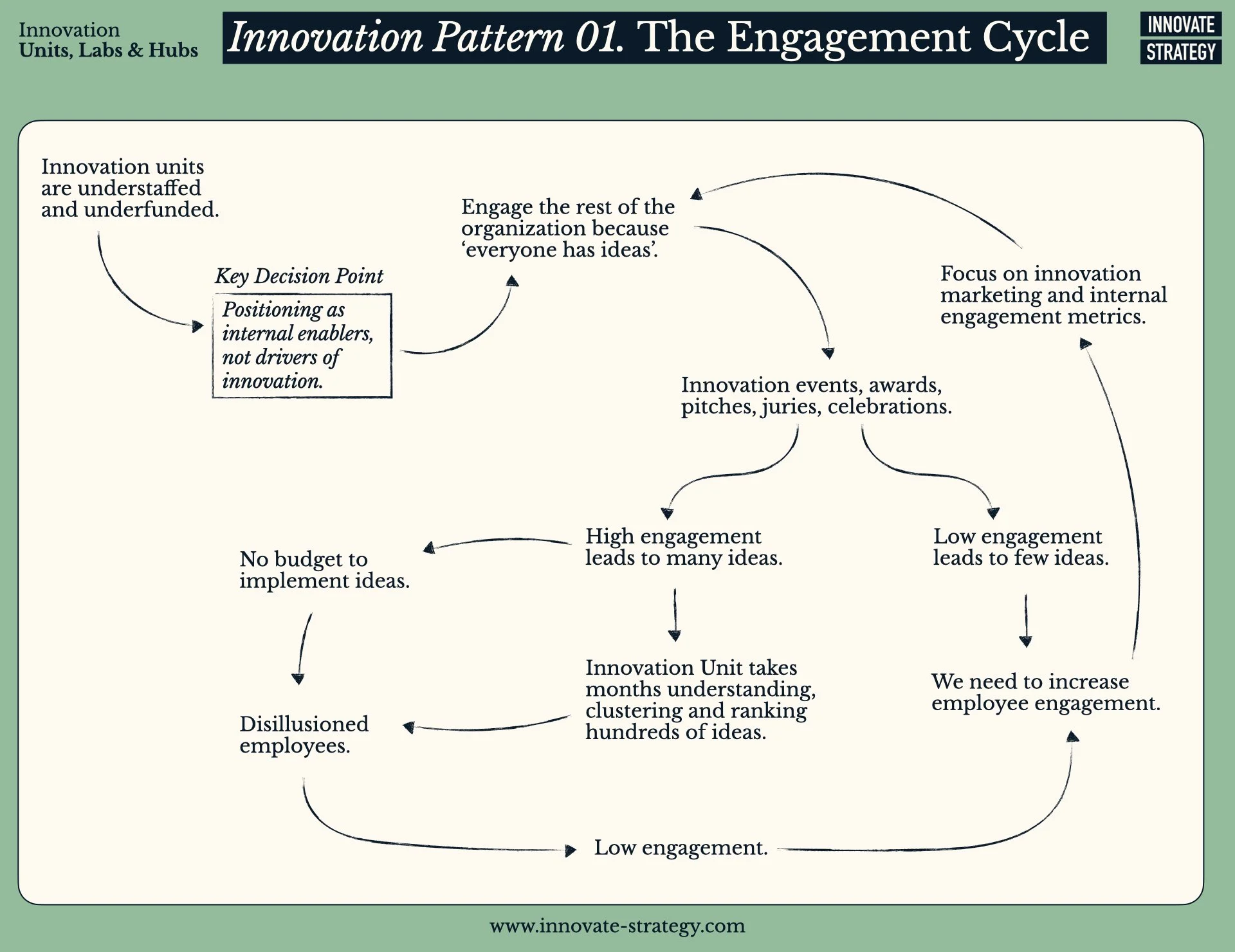
Paradoxically, chasing engagement often leads to disengagement.
The engagement trap
High engagement innovation programs have become so commonplace that few question its logic. But step outside the bubble and the contrast is obvious:
Can you imagine any other professional function relying so heavily on amateur input?
Would a marketing department crowdsource its campaign strategy from employees across unrelated divisions?
Would a sales team ask the entire company for ideas on how to close deals?
Of course not. Those disciplines rely on skilled professionals with clear mandates, resources, and accountability.
Yet in innovation, we do exactly that.
We invite everyone to contribute, regardless of expertise, and convince ourselves that idea volume equals progress.
It doesn’t. What looks democratic on the surface is structurally misleading.
The system behind the illusion
At the heart of the Engagement Cycle lies the belief that participation itself creates progress.
Everyone is invited to contribute, but few have the mandate or means to act.
Decision rights, budgets, and accountability remain elsewhere.
The system rewards visibility over market value.
The safest activity is to run events and collect ideas — visible effort without risk.
The hardest activity is to make a call, place a bet, and ship something.
Engagement grows because it feels democratic.
But democracy without decision power produces noise, not direction.
The result is a system that constantly expands its surface area while shrinking its business impact.
Innovation teams don’t set out to create theater, they drift into it because the structure leaves them no other option.
Early warning signs
When innovation loses focus, two new informal roles quietly emerge.
The second is the innovation marketer.
The internal promoter of innovation. This role is not aimed at customers or leadership but at colleagues.
Its purpose is to make innovation liked and understood across the organization.
Campaigns, newsletters, and roadshows follow, each designed to raise awareness and invite participation.
The message shifts from “Here’s what we’ve built” to “Here’s why innovation matters.”
The first is the innovation accountant.
A team busy measuring, sorting, and reporting. They cluster ideas, categorize submissions, and maintain dashboards of participation metrics.
They spend more time managing ideas than creating outcomes. New software tools are introduced to automate the process, idea platforms and engagement trackers.
Soon the team’s core competence becomes administration: keeping the system running, not creating value through it.
Both archetypes are symptoms of the same pattern. The focus of innovation turns inward - away from the market.
The end state, if uncorrected
Left uncorrected, the Engagement Cycle ends in quiet exhaustion. The innovation team slowly drifts into a role that sustains itself rather than the business.
The innovation accountants continue to measure. Participation rates, idea clusters, and engagement curves fill the reports, giving the appearance of precision without direction.
The innovation marketers continue to communicate. Newsletters, internal campaigns, and showcases keep the story alive even as its relevance fades.
Over time, trust erodes. Employees stop submitting ideas because they no longer believe anything will happen with them. Sponsors disengage because innovation fails to deliver business outcomes.
The intent was engagement. The result is disengagement.
The conclusion is always the same: innovation doesn’t work here.
How to break the Engagement Cycle
You cannot fix a structural problem with more enthusiasm, more communication, or another round of idea campaigns. Breaking the Engagement Cycle requires rebuilding the sequence: foundation first, engagement later.
1 – Revisit the early decision
If you must start small, act like a driver, not a cheerleader.
Claim a focused space where you hold decision rights and a small execution budget.
Building credibility through impact takes longer, but it’s solid, and it protects your unit when budgets tighten.
Participation does not build credibility; impact does.
In every crisis, high-visibility projects are the first to be cut.
2 – Build the foundation before engagement
Define two or three exploratory questions that anchor all activity.
Agree in advance who decides and what budget will be invested in exploring each question.
A team that knows its scope, funding, and decision logic does not need mass participation to stay relevant.
3 – Replace idea volume with decision quality
If an idea doesn’t link to an exploratory question or a significant problem, and a sponsor willing to invest in it, don’t pursue it.
Fewer, more qualified inputs lead to better decisions and clearer accountability.
4 – Earn credibility through problem solving
If you’re starting out with a small team and budget, focus first on solving tangible problems.
Deliver visible results for one or two important sponsors.
Sponsors remember who solved their problems; that’s how alliances and trust are built.
Once you’ve proven reliability in problem solving, you can take on higher-risk, higher-reward innovation work that explores new opportunities.
5 – Set engagement boundaries
Engage with purpose, not with volume.
Use your exploratory questions as the anchor for engagement.
The more specific the questions, the easier it is to invite the right people.
Bring in experts where their knowledge truly matters and define clear expectations and timelines for their contribution.
6 – Measure what matters
Replace participation metrics with evidence of value:
Customer behavior changes and willingness to pay
Cycle time from decision to shipped outcome
Cost avoided, risk reduced, revenue created
A quick diagnostic
The Engagement Cycle hides behind good intentions and positive energy. To see whether your innovation unit is caught in it, look at where time, attention, and credibility are really spent.
Ask yourself:
Do we spend more time explaining innovation than doing innovation?
When we talk about progress, do we show stories of activity or evidence of impact?
How much of our capacity goes into sorting, clustering, and marketing ideas rather than solving concrete problems?
Can we name the few sponsors whose problems we solved, and what changed for them?
If engagement suddenly dropped, would our impact shrink, or would our focus improve?
Do our metrics describe motion inside the organization or value created outside it?
The first step out is not more participation, but more precision, fewer ideas, better questions, and decisions that lead to tangible results.
The bottom line
Confront your engagement model. Innovation that depends on visibility will always chase attention; innovation that depends on impact can stand on its own.
You don’t need more participation. You need clear questions, real decisions, and visible results.
Engagement follows credibility,
not the other way around.
The goal is not to be liked or understood by everyone in the organization.
It is to create enough tangible value that you will never be shut down in a crisis.
Take your time and build a system that earns trust quietly, through the work itself.
This pattern is part of a series of five distinct patterns that explore common dynamics in corporate innovation:
Pattern 1 – The Engagement Cycle
Pattern 2 – The Cost Center Trap
Pattern 3 – The Startup Hype
Pattern 4 – The Overengineering Loop
Pattern 5 – The Fancy Lab Effect
Each pattern shows how good intentions in innovation often turn into structural traps, and how to avoid them. I hope this mini-series gives you a few useful lenses to recognize these dynamics early and to steer clear of the most common organizational pitfalls.
If you’d like to discuss how to course-correct or (re)design your Innovation Unit, Hub, or Lab before shutting it down I’m happy to help.
You can reach me directly at: