Why Innovation Units Fail. Five Patterns You Need to Recognize: 02 The Cost Center Trap.
A short Series On The Dynamics of Innovation Units, Labs and Hubs.
Understanding the patterns and key decision points that turn innovation into theatre.
A Personal Note
I have a personal relationship with this pattern because I have worked in both cost center and profit center innovation labs, and I have also helped build several innovation units operating under both models.
There are good reasons for choosing a cost center, just as there are good reasons for choosing a profit center. So this is not an argument against cost centers. What I would argue strongly, however, is that a cost center innovation unit still needs direct access to the market.
There should not be another department acting as the gatekeeper to customers, market intelligence, or market access. Once an innovation unit depends entirely on other parts of the organization to understand customers, test assumptions, or enter the market, its ability to create new value becomes severely constrained.
Building an innovation hub as a pure internal cost center therefore comes with structural difficulties that can make it much harder for innovation to play to its strengths.
And that is what makes this decision so consequential. The funding and positioning model is often chosen at the very beginning, when very little is known about how the unit will eventually need to operate. Yet that early decision shapes its role, its relationships, and its access to the market for years to come.
What It Is
The innovation unit is set up as an internal cost center. It receives a budget, has dedicated people, and must justify the resources it uses. Accountability leads to a simple question: What does the innovation unit provide in return?
So the unit begins defining its services. Workshops. Facilitation. Idea generation. Prototyping. Innovation methods. Project support. Trend research. Venture support. Instead of creating new market value, the innovation unit begins providing innovation services to the organization. The business becomes its customer. And that changes almost everything.
How It Starts
The organization invests in a dedicated innovation capability, and that capability needs to prove its value. The easiest way to do this is to help existing business units. So the innovation team moves into the second row.
Instead of exploring new value by asking, “What is changing in the market, and what new value could we create?”, it starts serving existing needs by asking, “How can we help business units solve their innovation challenges?”
The difference may sound small. It is not. The first question has a reference outside the organization. The second uses an internal reference. Once the innovation unit becomes an internal service provider, internal demand determines its focus.
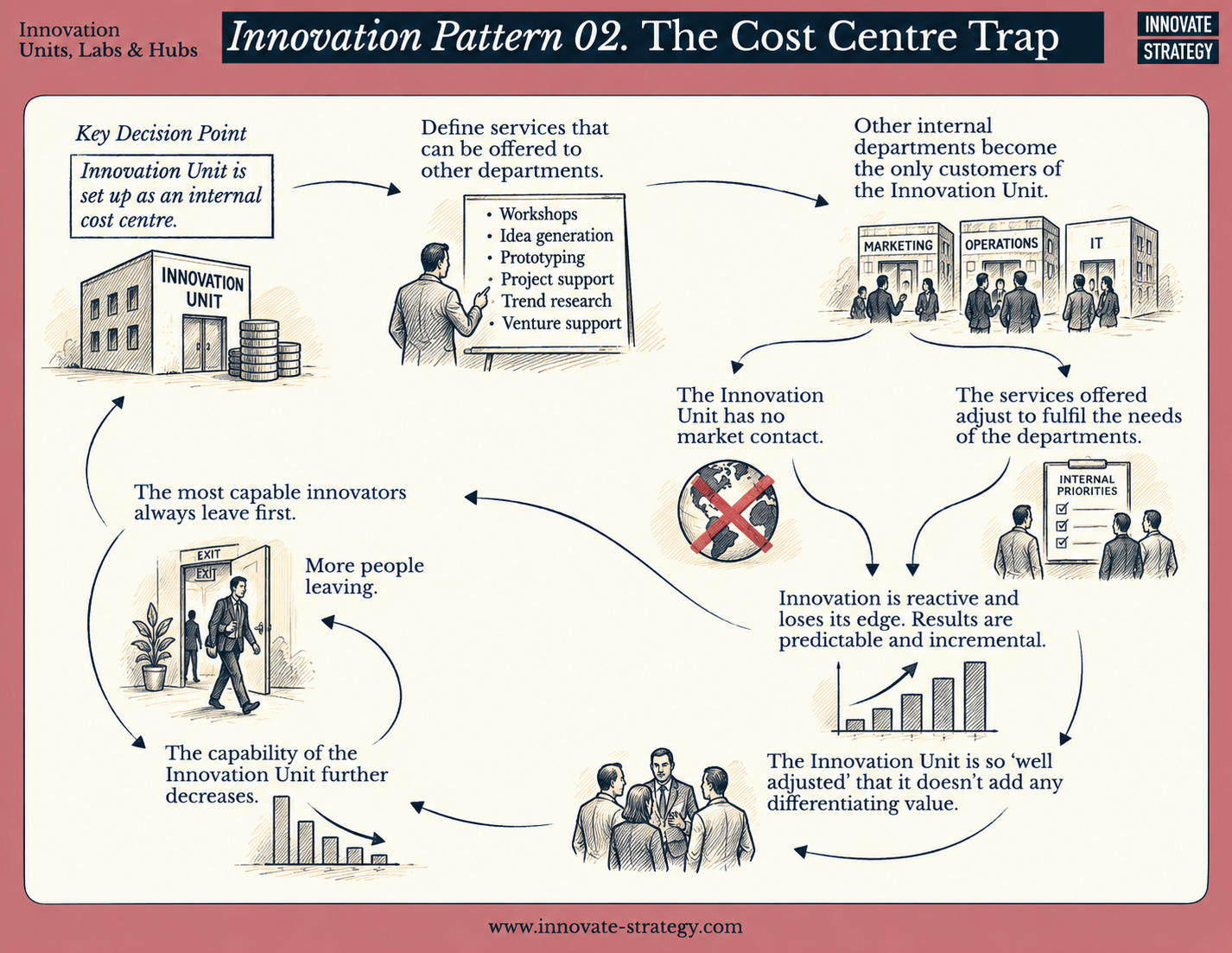
Innovation Pattern 02. The Cost Centre Trap
The innovation unit now needs to show it is useful, so it asks internal departments what they need. Those departments naturally ask for work that fits their current priorities, problems, budgets, and assumptions. Because these internal projects create visible demand, they become proof that the unit is needed. So the team does more of them. Over time, the organization becomes its main, and often only, customer.
Direct market contact declines, exploration becomes less important than responsiveness, and success becomes defined by internal satisfaction metrics. The better the team gets at serving internal demand, the further it moves from creating new external value. The unit becomes better adapted to the organization and less adapted to the market.
The System Behind the Pattern
At the heart of this trap is a simple structural problem: Your customers shape what you become.
When your customers are external, the market decides what succeeds. Customers choose whether something is useful enough to adopt, buy, recommend, or pay for. Competitors create pressure. New technologies change expectations. Shifts in behavior expose old assumptions.
When the organization is the customer, a different selection system takes over. Internal clients tend to favor concepts they understand, initiatives they can approve without personal risk, solutions that fit current structures and priorities, and work that is easy to integrate.
None of this is irrational. But it works against what innovation should provide: differentiated new value.
The organization unknowingly domesticates innovation. Project by project and feedback by feedback, the innovation team learns what its internal customers want. Eventually, it becomes very good at delivering exactly that.
The Loss of Core Capability
This is not unique to innovation. A common example of this dynamic is internal consulting. Without market contact, without external customers, without competition, you cannot advise from an independent and external perspective. You cannot challenge the organization that you are part of.
Over time, internal consulting units become a sophisticated project management and improvement function that operates far below its potential contribution.
Why Your Best Innovators Leave First
Highly capable innovators are rarely motivated mainly by facilitating internal projects. They want to understand market dynamics, challenge assumptions, build new things, test ideas in reality, and create something that does not exist.
When their work increasingly involves responding to internal requests, supporting existing efforts, and coordinating stakeholders, many will leave. The people least comfortable with an internal service model leave first. Those most comfortable within it stay.
The capability becomes even more aligned with internal demand. That makes it less appealing to strong innovators, which causes more of them to leave. A structural decision leads to a talent problem.
Early Warning Signs
The Cost Center Trap doesn’t look like a crisis; it looks like growing professionalism. Most projects begin with internal requests rather than market observations, internal stakeholder satisfaction becomes a key success measure, and the team spends more time in internal meetings than with customers, partners, competitors, or in market exploration.
Innovation increasingly means workshops, facilitation, project support, and methods. The portfolio closely reflects existing business unit priorities, opportunities without a clear internal owner struggle to survive, and strong innovators become frustrated by coordination and service work.
The most dangerous signal is also easy to miss: No one is surprised by what the innovation team produces.
The End State
If left uncorrected, the Cost Center Trap creates an innovation unit that is highly integrated, responsive, and increasingly irrelevant to new value creation.
It knows its stakeholders well. It understands internal processes. It speaks the organization’s language. It knows what management will approve and which ideas will face resistance. So it stops bringing those ideas forward.
Innovation becomes reactive. Then predictable. Then incremental. Then dispensable.
Eventually, leadership looks at the portfolio and asks why innovation is not producing anything meaningful. They may conclude that the team lacks entrepreneurial thinking. But the problem started much earlier: The internal customer trained the innovation unit to become exactly what it is today.
How to Break the Cost Center Trap
The answer is not simply turning a cost center into a profit center. We need to change where accountability comes from.
Innovation needs external accountability. It needs exposure to customers, competitors, partners, technologies, and changing behavior. It needs consequences outside the organization. That requires several structural changes.
1. Reconnect Innovation Directly to the Market
Do not rely on business units as substitutes for customers. Innovation teams need direct access to customers, non customers, partners, competitors, and markets. They need to observe changing behavior themselves and hear things that others may not want to hear. Market contact should be part of the mandate.
2. Stop Treating Business Units as Customers
Business units can be partners. They can provide expertise and assets. They can help scale opportunities later on. But they should not be the only customer of innovation work. Otherwise, every opportunity must first survive an internal selection process before reaching the market. That process naturally favors what fits today’s organization.
3. Create External Customers
One of the strongest ways to reduce internal dependency is requiring part of the portfolio to create value for real external customers. These do not have to be existing customers. They may be other companies, partners, new customer groups, or entirely new markets.
What matters is that someone outside your organization cares enough to engage with it. Even better, someone should eventually commit something: time, data, access, partnership support, or money. External commitment is far harder to fake than internal enthusiasm.
4. Protect Capacity for Unrequested Opportunities
If all capacity goes toward internal demand, then internal demand will use all available capacity. Set aside clear capacity for opportunities without an internal sponsor yet. These may be exactly the opportunities that challenge current assumptions most directly. A lack of internal demand should not automatically mean an opportunity has no value.
5. Separate Improvement Work From Opportunity Creation
There is nothing wrong with helping teams solve problems. But call it what it is. Improvement work and opportunity creation begin from different places. Improvement starts with something known that needs changing. Opportunity creation starts with uncertainty about where new value might exist.
Both matter, but if they share one budget and one queue, urgent internal issues always win. Make room for both.
6. Change How Legitimacy Is Earned
An internal service function proves value through demand: How many projects did we support? How many workshops did we run? How satisfied were our internal clients?
An innovation function needs a different type of evidence: What changed in customer behavior? What assumption did we disprove? What willingness to pay did we discover? What external commitment did we secure? What new source of value became possible?
These questions change what teams optimize for.
7. Rethink Funding Logic
A pure cost center model sends a strong message: the innovation unit consumes resources and must justify them internally.
There are other options. Corporate funding can protect longer term exploration. External revenue can create market discipline. Business units can co invest once evidence reaches a defined point. Partners can share risk. New ventures can take on their own economic accountability as they mature.
The exact approach will vary by organization. But one principle matters most: Do not build a system where your innovation unit depends entirely on pleasing one customer, your own organization.
A Quick Diagnostic
Ask yourself who your real customer is, what percentage of your work starts with an internal request, how much time your team spends directly in market exploration, and whether you can pursue an opportunity no business unit currently wants.
Also consider what external evidence matters in investment decisions, when an external customer last paid, committed, partnered, or meaningfully changed behavior because of something you created, and whether your best innovators are building new value or mainly supporting internal projects.
One final question can be especially revealing: If all internal demand disappeared tomorrow, would you still know which opportunities to pursue?
If your answer is no, you may not actually have an innovation capability. You may have an internal service function.
The Bottom Line
Innovation needs market contact.
Once an organization becomes its only customer, innovation begins adapting to internal preferences instead of external change. At first, this can make a team look more useful, integrated, responsive, and professional. Over time, that same adaptation removes what made it valuable in the first place.
The goal is not to separate innovation from the organization. The goal is to keep the organization from becoming its only reference. Innovation should help organizations see what they cannot already see, not simply deliver what they request.
If your innovation unit serves only internal customers, do not be surprised when it creates only known answers. The market needs a seat at the table. Ideally, it should also have a vote.
This pattern is part of a series of five distinct patterns that explore common dynamics in corporate innovation:
Pattern 1: The Engagement Cycle
Pattern 2: The Cost Center Trap
Pattern 3: The Startup Hype
Pattern 4: The Illusion of Control
Pattern 5: The Fancy Lab Effect
Each pattern shows how key decisions in innovation often turn into structural traps.
If you’d like to discuss how to course correct or redesign your Innovation Unit, Hub, or Lab before shutting it down, I’m happy to help.
You can reach me directly at: