Why Innovation Units Fail. Five Patterns You Need to Recognize: 04 The Illusion of Control.
A Personal Note
A significant part of my work has been with engineering companies, often German global market leaders. This is one pattern I have encountered particularly often in engineering driven organizations.
These companies became successful through precision, reliability, and continuous improvement. You measure twice. Tolerances matter. Processes are optimized until outcomes are highly predictable. These capabilities are crucial for engineering and mass production.
But I have also seen what happens when this logic is applied to innovation. When results disappoint, the instinct is to specify more, measure more, define more milestones, and tighten the process. What works exceptionally well when the desired outcome is known becomes limiting when the goal is to create something unexpected or surprising, aka innovation.
What it is
The illusion of control often begins with a familiar response to disappointing innovation results: management decides to define success more precisely. If projects take too long, milestones become more frequent. If outcomes are unclear, objectives become more specific. If leaders cannot tell whether a project is advancing, more progress indicators appear. If decisions feel risky, the organization adds stage gates, review meetings, assessment criteria, and approval points.
The assumption is straightforward: uncertainty will decline if we specify more clearly what should happen, when it should happen, what evidence is required, and who authorizes the next step. When a process is repeated and the desired outcome is known, greater specification reduces variation and improves reliability. Innovation is different. Its purpose is to discover something new that cannot be fully specified in advance. We try to reduce innovation risk by deciding more about the destination and the route before we begin, but in doing so, we remove the freedom required to respond to what we learn along the way.
Something more consequential happens: responsibility gradually moves from the innovation team into the process.
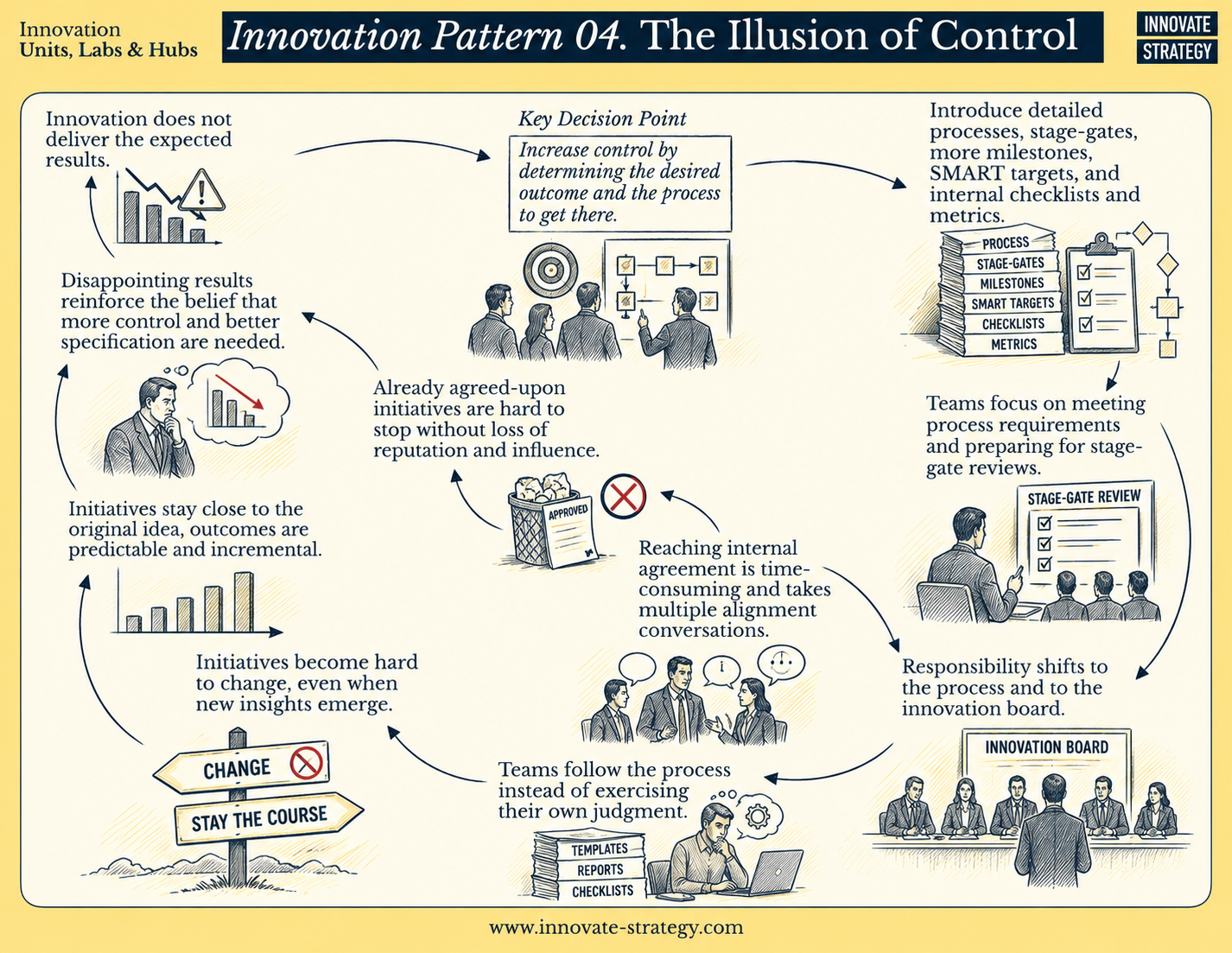
Innovation Pattern 04. The Illusion of Control.
How It Starts
The pattern usually begins when leadership becomes dissatisfied with innovation output. Too many projects fail. Initiatives take longer than expected. Spending does not seem connected to business results. Teams appear to be moving in different directions.
The instinct is to professionalize. Define an explicit process and make it binding. Divide projects into stages with defined objectives. Make milestones more frequent and detailed. Require teams to set measurable targets, produce evidence, and prepare formal decisions before proceeding.
Ambiguity recedes. People know the next milestone, the expected slide deck, and the evidence they must present. The innovation board can now decide, using a checklist, whether an initiative should continue. But this clarity changes the nature of responsibility. When a process determines what should happen next, the team no longer has to decide what should happen next. It has to comply with the process.
When Responsibility Moves Into the Process
When an innovation team must complete a prescribed set of activities before appearing before an innovation board, and that board decides whether the initiative advances, the team can justify its actions neatly: We followed the process. We completed the experiments you asked for. We reached the milestone as planned. We presented the evidence.
Now it is up to the innovation board to approve the next stage. Responsibility is no longer located primarily with the people who have explored the opportunity. It sits partly in the process and partly with senior leadership.
The innovation team is no longer in a position to decide whether continuing makes sense; it is expected to follow the process. This may look like good governance, but it weakens what innovation needs most: judgment.
Judgment Cannot Be Replaced
Innovation depends on judgment because much of its relevant information cannot be reduced to predefined metrics. A team may notice that customer conversations are becoming less enthusiastic even though formal validation criteria are being met. It may see a more promising opportunity emerging beside the original one. It may realize that it framed the problem incorrectly or that market conditions have changed enough to weaken the initial business case.
Reality does not respect stage gates. Important market signals do not arrive on schedule. They emerge after a team has immersed itself deeply in a topic while holding several, sometimes conflicting, perspectives at once. Those perspectives require judgment.
A tightly managed system has little room for it. A team may know that its initiative needs substantial change, yet changing direction means reopening assumptions that have already survived several approvals. It may sense that a project should stop, but stopping requires explaining to leaders who recently authorized further investment that the basis for their decision has shifted.
Approval Is a Hard Currency
Approval is difficult to achieve in established organizations. It may take weeks to prepare for a senior management decision: aligning stakeholders, refining the story, answering objections, building support, and creating confidence around an initiative. When senior leadership finally approves another stage, that approval has value. The project gains legitimacy, resources, political protection, and often senior sponsors.
Each additional gate therefore creates organizational commitment that makes changing direction harder later. As an initiative progresses, this becomes increasingly expensive socially and politically. The team may need to challenge its own recommendations. It may need senior leaders to reconsider decisions they have already backed. It risks losing legitimacy it worked hard to acquire.
Under those conditions, continuing feels easier than changing direction.
The Cycle It Creates
Innovation fails to produce sufficient impact. Management concludes that it needs more control. Expected results become more precise; work is divided into smaller stages; milestones multiply; metrics become increasingly specific; required evidence becomes unambiguous.
Teams adapt by working toward internal milestones because those milestones determine whether their projects survive. Responsibility shifts from team judgment toward compliance and internal approval. New learning is interpreted to fit the expectations of internal stakeholders who have already said yes. Eventually outcomes become predictable, incremental, and disappointing. Leadership sees weak results and asks for still more rigor. Another layer of control arrives.
Measures intended to reduce failure gradually increase its likelihood.
The Organization Feels More in Control
The illusion persists because it feels professional. There are clear stages and defined responsibilities. Projects receive regular reviews. Leaders get information from dashboards. Decision criteria exist. Funding decisions occur at formalized checkpoints where initiatives can be continued or stopped.
But what has become controllable is the internal process, not the external outcome. Management can see whether a team completed required activities or reached its milestone. It can see whether a committee approved continuation. None of this means anyone understands the opportunity better.
A managed innovation process can therefore create a dangerous substitution: process visibility replaces market understanding; internal approval replaces external validation; progression through stages replaces creation of new value.
Eight Years to Define an Innovation Process
I once encountered a German engineering giant, a global market leader whose brand you would recognize, that had spent eight years developing its internal innovation process.
Eight years.
It repeatedly refined its system because it wanted innovation to become more reliable, systematic, and professional. Every problem suggested an improvement; every exception required another rule; every uncertainty produced another criterion; every failure revealed something the process should handle next time.
The result was an exaggerated version of what this organization already did exceptionally well: engineering. It engineered innovation, then engineered its innovation process, then continued engineering the system designed to manage that process. From inside the company, the logic was understandable. Engineering had created its success.
But innovation is not simply another engineering problem. Engineering excels when desired requirements can be specified precisely. Innovation succeeds because its most important aspects are unknown and cannot be specified. The competence that creates reliability in core operations can become a liability when applied directly to discovery work.
Underdetermination Changes the Logic
This is where underdetermination becomes useful as a design principle. An underdetermined innovation system does not lack direction or accountability. It deliberately chooses not to predetermine every variable. The resulting system leaves degrees of freedom that teams can use to create something new.
Leadership can and should define available resources and unacceptable risks. But it does not need to specify every step in advance. Established organizations often believe they are providing useful structure when they are actually locking assumptions into place.
What Happens When We Lose Judgment
The long term consequence is that we weaken our people’s ability to make good judgment calls. Judgment develops through repeated exposure to ambiguous situations in which someone must interpret incomplete evidence and take responsibility for a decision. We learn which customer signals matter; when enthusiasm is superficial and when it suggests something deeper; how to distinguish an interesting insight from an actual opportunity; when uncertainty deserves patience and when we should stop.
These abilities cannot be codified because they depend on people acting within a specific context. They require experience and responsibility. If important decisions are prescribed in a process or automatically escalated to a board, teams have little opportunity to develop them.
We do not need much judgment to navigate internal governance systems. But we do need it to navigate uncertainty in dynamic markets.
The Role of Measurement
Measurement matters because teams need evidence. The problem begins when the required evidence is defined too narrowly and too early. A metric tells teams what an organization considers meaningful. Once attached to a stage gate, it also becomes something teams must produce. Teams seek evidence that satisfies internal criteria instead of collecting evidence that would change their view of an opportunity.
Weak signals that don’t fit inside the framework receive less attention. Unexpected or conflicting findings become inconvenient because they do not help move a project through a formal review process. The system grows more precise while becoming less sensitive.
Innovation needs enough discipline to distinguish evidence from wishful thinking but enough openness for new evidence to change direction. Measurement should support judgment, not replace it.
Why It Gets Worse Over Time
The illusion of control accumulates almost automatically. More stage gates produce more reporting. More reporting produces more metrics. More metrics create higher expectations about how progress should look. Those expectations shape project selection, and selected projects increasingly resemble what existing processes can evaluate.
The portfolio becomes less differentiated. Leadership sees insufficient impact and asks for stronger governance. This is how an innovation system becomes overengineered without anyone explicitly deciding that excessive control would be useful. There is only a sequence of reasonable interventions moving in one direction.
Early Warning Signs
Internal milestones begin to count as achievements. Teams devote large amounts of time preparing for review meetings because those meetings determine whether they may continue working. Projects become increasingly difficult to change after passing several gates because each gate represents internal support.
Perhaps most revealingly, when significant new information emerges, teams first ask how it affects their process rather than how it affects their opportunity. At that point, process has become the main lens through which reality is interpreted.
The End State
If left unchecked, an organization builds an innovation system that is professionally managed internally and underperforming externally. The process looks right; governance is clear; projects move through recognizable stages; management receives regular evidence; responsibilities seem distributed across roles and committees.
But the responsibility for judging opportunities has become blurred. Teams point to process requirements; boards point to evidence supplied by teams; senior leaders point to formal decision criteria. Everyone followed the system, which is why outcomes are weak.
Responsibility can be distributed so effectively that nobody owns judgment.
How We Break the Illusion
The answer is not eliminating process altogether. Innovation teams need structure, while senior leaders have legitimate responsibilities around capital allocation, risk management, and strategic direction. The issue is how responsibility and judgment are built into that structure.
Leadership should distinguish between decisions it genuinely needs to make and those best left with people closest to an opportunity. A board may decide how much capital an organization will invest or which risks are unacceptable. It should not decide every time a team revises a customer assumption, reframes an opportunity, or changes its approach based on new evidence.
Teams must be responsible for opportunities, not for following procedures. They need authority to adapt when evidence changes their understanding of reality. Changing direction should not signal inconsistency; often it shows that people are paying attention.
We must also preserve reversibility. Approval should not turn an assumption into fact. An initiative may become weaker after receiving support; previous decisions should remain open when new evidence changes circumstances.
Finally, organizations should treat judgment as a capability worth developing. Strong teams get better at assessing opportunities, interpreting evidence, judging risks, and deciding what merits further investment under uncertainty. If every difficult decision moves out of teams and into governance structures, those capabilities never mature.
This pattern is part of a series of five distinct patterns that explore common dynamics in corporate innovation:
Pattern 1: The Engagement Cycle
Pattern 2: The Cost Center Trap
Pattern 3: The Startup Hype
Pattern 4: The Illusion of Control
Pattern 5: The Fancy Lab Effect
Each pattern shows how good intentions in innovation can turn into structural traps, and how to avoid them.
If you’d like to discuss how to course correct or redesign your Innovation Unit, Hub, or Lab before shutting it down, I’m happy to help.
You can reach me directly at: