Why Innovation Units Fail. Five Patterns You Need to Recognize: 03 The Startup Hype.
A short Series On The Dynamics of Innovation Units, Labs and Hubs.
Understanding the patterns and key decision points that turn innovation into theatre.
A Personal Note
In 2013, I read Eric Ries’ The Lean Startup. I did not just read it. It influenced how I thought about innovation and how I advised established organizations.
Over the following years, I tried to bring startup approaches into corporate environments. I worked with lean startup principles, rapid experimentation, intrapreneurship, and many of the ideas that were popular at the time.
With mixed success.
It became clear to me that established organizations do not move differently simply because they lack the right methods, enough agility, or the right mindset. Startups and established companies operate in very different contexts, with different structures, responsibilities, incentives, risks, and decision systems.
Today, I still believe there are valuable things corporates can learn from startups. But I am skeptical of the idea that startup approaches can be transferred into an established organization.
That experience is part of why I wrote this pattern.
What it is
The Startup Hype begins with a valid observation. Startups move faster than large organizations. They test quickly, adapt rapidly, and reach the market at a pace corporates often envy. From this, a seductive belief emerges: If only we behaved like startups, with our resources, customers, and brand, we would be unstoppable
It sounds logical, but it’s an illusion.
How it starts
Executives notice that startups ship sooner and change direction faster. The conclusion becomes imitation: “We should act like a startup.” There’s a plethora of startup methods, playbooks and tools that monetize on this illusion: lean startup, intrapreneurship programs and hackathons. The next step is to search for intrapreneurs, internal founders, people who can act like entrepreneurs inside the system.
In practice this rarely works, because the context startups operate in is fundamentally different to a corporate context.
The cycle it creates
What begins as an attempt to speed things up turns into a self-reinforcing loop that actually slows innovation down. The more organizations try to imitate startups, the more they expose the constraints that make them slow. Instead of removing bottlenecks and structural barriers to innovation, they layer startup rituals on top of corporate systems, creating the appearance of agility.
What follows is predictable: pilots die at handover, innovation fatigue sets in, and the organization returns to old habits, only now with more cynicism.
Paradoxically, the attempt to speed things up by acting like a startup is more likely to slow corporates down.
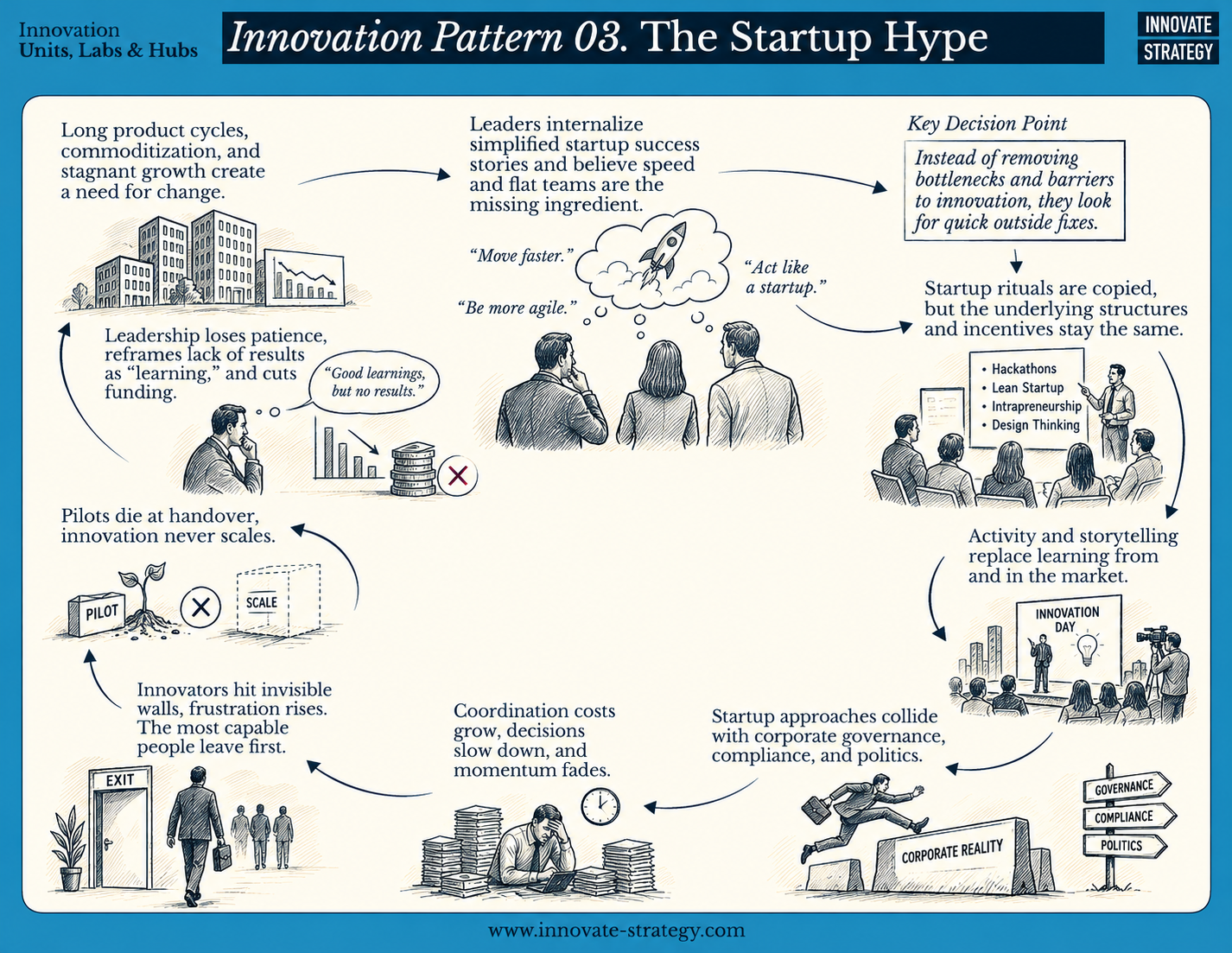
Innovation Pattern 03. The Startup Hype.
The system behind the illusion
At the heart of the Startup Hype is a structural fallacy: the belief that entrepreneurship is a mindset. Employees are invited to step up as “intrapreneurs.” Resources are given to test ideas, but decision rights stay with management.
Intrapreneurs often carry responsibility without authority, while the board still controls the money. Without personal risk, employees don’t behave like actual entrepreneurs. Without personal upside, they don’t lean in like actual founders. This is not a mindset problem. It’s a governance problem. Entrepreneurship depends on ownership, risk, and reward, all of which remain locked at the top.
Early warning signs
The Startup Hype is hard to notice, because in the beginning, early symptoms look like progress. Intrapreneurs carry “responsibility”, but can’t make final calls. Funding still requires board or executive approval. Projects get ground down in politics and governance. Your best people begin to leave because they lack agency.
The end state, if uncorrected
Left uncorrected, the Startup Hype turns into a theater of entrepreneurial role play. Employees act like founders, but ownership, risk, and upside remain at board level. As a result decisions slow down again, projects shrink to fit the legacy system, and cynicism emerges.
How to break the Startup Hype Pattern
You cannot fix structural problems with celebrating failures or adopting startup rituals. Breaking the Startup Hype requires structural work.
Intrapreneurship is often presented as corporate entrepreneurship, but without real ownership, risk, or reward, it’s an empty promise. Entrepreneurship requires decision rights, personal risk, and upside. These elements rarely exist inside large organizations. I have yet to see a case where intrapreneurs genuinely hold the power to decide and to lose, or to gain in proportion to their bets.
Instead of copying startups, use the unfair advantages only corporates have: the ability to scale proven ideas faster, leverage existing customer trust and distribution, invest at larger ticket sizes once evidence exists, and integrate new solutions into established platforms and supply chains.
Give real decision rights, or stop using entrepreneurial language. If you want people to act like founders, give them authority that matches their responsibility: budget autonomy, clear governance, and access to shared infrastructure. Otherwise intrapreneurship becomes theater.
Build hybrid models that link, not mimic. Combine corporate stability with entrepreneurial agility where it adds real value. Partner with external founders through venture building and shared equity. Co invest with startups where risk and upside are defined contractually. Set up hybrid teams with a clear scale path and platform access.
The bottom line
Confront your own operating system. Innovation will never be faster than the structures that govern it. You don’t need to act like a startup, and you don’t need to adopt an agile transformation program either. The key is in removing barriers, not in adding new practices that don’t fit your context.
By removing barriers and bottlenecks, you build a system that can move at a healthy pace, one that keeps up with the market and, ideally, runs even faster than your competitors.
This pattern is part of a series of five distinct patterns that explore common dynamics in corporate innovation:
Pattern 1: The Engagement Cycle
Pattern 2: The Cost Center Trap
Pattern 3: The Startup Hype
Pattern 4: The Illusion of Control
Pattern 5: The Fancy Lab Effect
Each pattern shows how key decisions in innovation often turn into structural traps.
If you’d like to discuss how to course correct or redesign your Innovation Unit, Hub, or Lab before shutting it down, I’m happy to help.
You can reach me directly at: